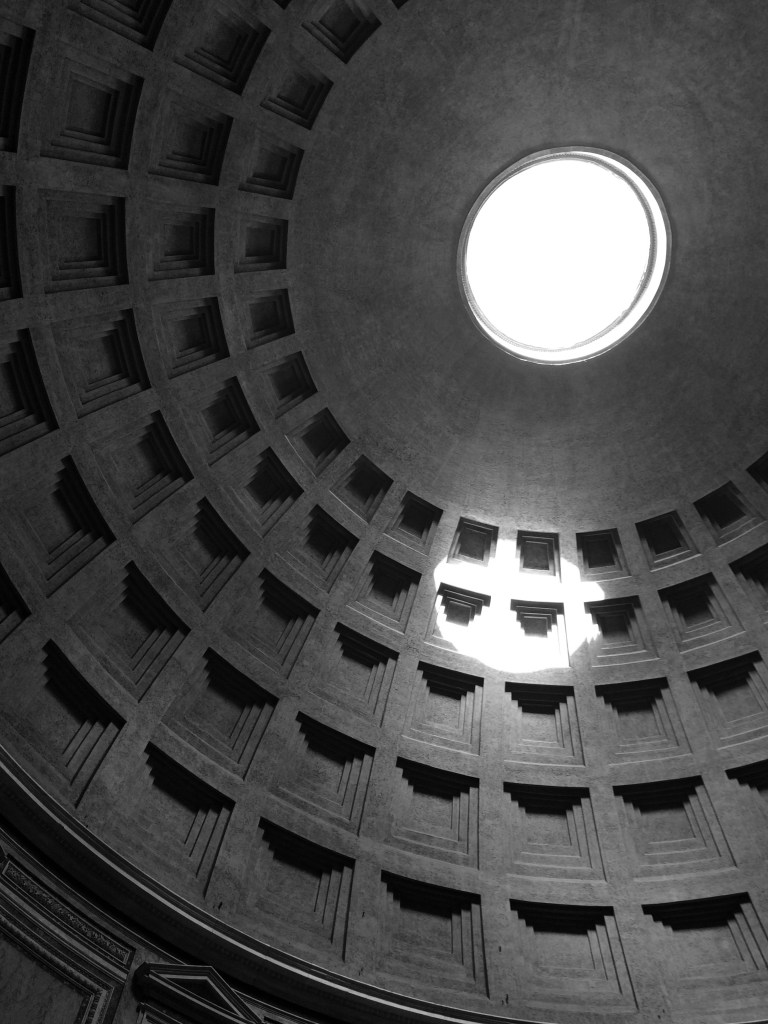
At first glance, particularly in the eyes of architects, readers of architectural criticism, even avid watchers of home decorating shows, “architectural space” is the most straightforward of the phrases in the original hypothesis. It is a mantra, practically, in architecture schools – an article of faith amongst architects. With each reading, however, the phrase grows vaguer. If pondered long enough, it transforms into an oxymoron bordering on an antinomy.
“Architectural” applies to formed matter. Architecture, in other words, is limited to things that can be conceived, ordered, and built. “Space,” on the contrary, is the absence of form or matter. It cannot be built, ordered, or, if we are honest, even conceived. Those who argue they conceive space do so, presumably, by imaginative projection in which they convert absence into a quasi-solid. The resultant “space” is an imaginary one stripped of its essential quality of absence/non-existence in order to be an object comprehensible to the mind. It is this non-space-like mental construct that people manipulate when they congratulate themselves for ordering space.
I’ve written about false notions surrounding architectural space elsewhere, calling it an example of Alfred North Whitehead’s fallacy of misplaced concreteness – the misattribution of “reality” to something that is unreal.[i] The fact that humans imagine spaces into the world is not a problem. Arguably, it is an essential human activity. The phrase “architectural space”, however, should not be used naively as shorthand for richer or more complex phenomena. “Architectural space” is shorthand like all others insofar as it elides content – specifically, the human role in space making/imagining – and is misleading as a result.
To be clear, we do not have to be aware of our role in space making in order to enjoy occupying a building or reading a book. There is no harm in architects and others choosing to see the artifacts of culture as doing all the work to create perceptions of place. Occupants’ or readers’ experiences probably are best when naïve. The attribution of my experiences of the Pantheon’s interior and my grandparents’ basement to the literal limitations of the physical matter around me does not modify MY experiences. There is, in fact, little doubt that the architectural setting provides a frame limiting, directing, and expanding my possible interpretations and the conditions of place I project into the void. The formed matter around us does some of the work and it is okay if we are unaware of our own role in forming the rest.
But wherein resides the experience of space? Space does not belong to the basement any more than it is a product of the Pantheon’s vast dome. The basement is composed of innumerable material and formal traits. The Pantheon, likewise, is concrete and marbles organized in precise patterns and proportions. But space is not inherent in either. Space, to the extent it exists, isn’t a Being captured or created by an architectural construction. Spaces are entities generated within the minds of humans and cast out upon the world of things.
Even in this formulation, the word space is misleading insofar as it suggests a projection absent of qualities. Reality is more nearly the opposite. In an architectural setting, people do not perceive absence but project presence. They rehabilitate absence as a place. The dark atmosphere of my grandparents’ basement and the sunlit void of the Pantheon are made into places by inhabitants. “Architectural space” is, therefore, more faithfully rendered as a human projection of place occurring within and against an architectural setting. And this reversal, while it matters little to the casual observer of architecture, is a Copernican revolution for the orientation of a meaning-oriented practice.
[i] Jassen Callender, Architecture History and Theory in Reverse: from an information age to eras of meaning, (New York: Routledge, 2018), 90-98. See also, Alfred North Whitehead, Science and the Modern World, (Cambridge: Cambridge University Press, 2011, 1925), Chapter III.
 Architecture is Fiction