One of the many reasons I am enamored of calling architecture “fiction” lies in the affinity between literary and architectural experiences of time and the degree to which authors and architects are responsible for framing or creating those experiences. The two types of creators, of course, differ in the forms that their creations ultimately take. More importantly, they differ in their cognizance of the relationship of time and narrative. Here is where literary theory can teach us.
Paul Ricoeur is a philosopher I turn to often in these meditations. His Time and Narrative is a must read for architects, in my opinion. At the moment, I am particularly interested in his elaboration of the differences between “the time of narrating” and “narrated time.” From this distinction, originally introduced by Günther Müller and extended by Gérard Genette, he identifies “a three-tiered scheme: utterance-statement-world of the text, to which correspond a time of narrating, a narrated time, and a fictive experience of time.”[i] My simple diagram attempts to locate these interrelations of time and text.

The real value of such diagrams lies in their expandability. To ‘Time’ and ‘Text,’ we might add ‘Place’ or ‘Architecture.’ There are far too many unknowns to write the final version of an expanded table at present. We can, however, outline a provisional version based on what we’ve covered so far.
The first column of the table, relative to time, is ‘Narrating.’ According to Ricoeur, narrating is choosing and excluding.[ii] In the physical world and in the terminology of Francis D.K. Ching’s classic Architecture: Form, Space and Order, the experience of choosing and excluding aligns most closely with Path. Path is an amalgam of trajectory and non-changing features of experience. J.J. Gibson points to the horizon, to the relatively fixed nature of earth and sky, as the datum against which we measure our movement.[iii] Architects have an expanded array of surfaces that can be composed as datums, in addition to earth and sky.
‘Narrated time’ occupies the second position in the table. It is the time embedded in, or written into/read out of, a statement. The corollary of embedded time in physical experience is spatial. Stated differently, the internalized fiction of Space plays a pivotal role in experience. To operate along a path or understand where/when one is, a spatial framework – what Axel Seeman calls a conception of space – is necessary.[iv]
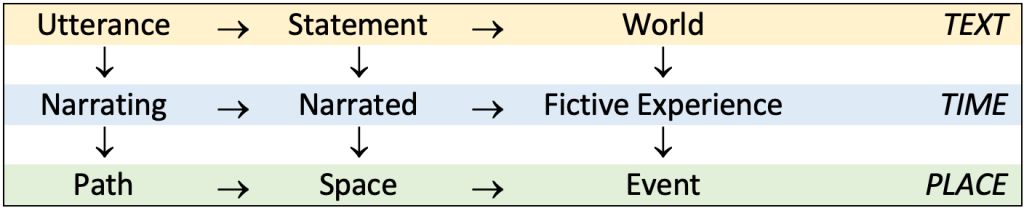
The ‘World’ of ‘Fictive Experience’ is an emergent phenomenon. In architectural experience, moving along a path relative to spaces creates the impression of a plot, a series of Events. A provisionally expanded table might, therefore, look like the one above. This last step in the evolution of experience, however, is not just physical movement registered against fixed surfaces. Or I should say, not simply. Events, especially those that rise sufficiently in consciousness to register as ‘events’, are complex mixtures of specificity and a sense of the indefinable. In literature, the great novelist Italo Calvino might call this exactitude in the service of vagueness. As he writes of Giacomo Leopardi, “what he requires is a highly exact and meticulous attention to the composition of each image, to the minute definition of details, to the choice of objects, to the lighting and the atmosphere, all in order to attain the desired degree of vagueness.”[v]
This is the heady mix we pursue next.
[i] Ricoeur, Time and Narrative, Volume 2, 77.
[ii] Ricoeur, Time and Narrative, Volume 2, 78.
[iii] Gibson, The Ecological Approach to Visual Perception, 114-115.
[iv] Seeman, The Shared World, 91-98.
[v] Calvino, Six Memos for the Next Millennium, 60-61.
 Architecture is Fiction